Pulsed Laser Diodes
Laser Diodes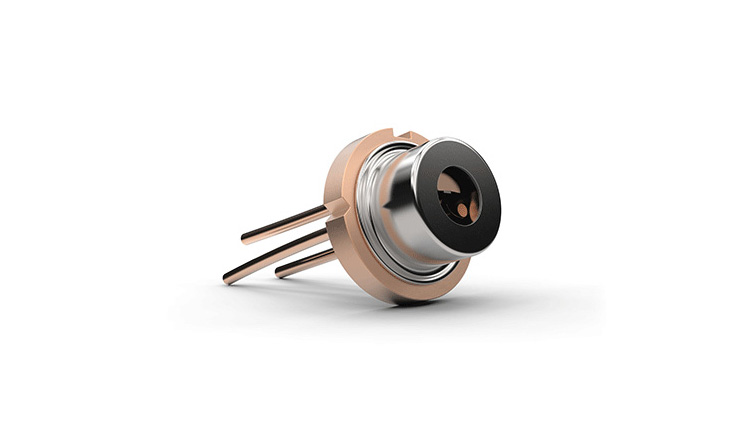
Pulsed Laser Diodes for LiDAR, Rangefinding and OTDR
High optical peak power in short pulses: SemiNex pulsed laser diodes are ideal for demanding time-of-flight systems, laser rangefinders, industrial 3D sensing applications, and fiber optic diagnostics. IMM Photonics supports you in selecting the optimal wavelength, output power, package type, and optics, all the way through to custom integration.
What Is a Pulsed Laser Diode?
A pulsed laser diode is a semiconductor laser diode operated with short current pulses. This enables it to deliver high optical peak power for nanoseconds, while the average output power remains significantly lower due to the duty cycle. This operating mode is ideal when a large number of photons are required within a short measurement window.
1550 nm Triple-Junction Laser Diodes
In triple-junction technology, three laser structures are monolithically integrated on top of each other. This significantly increases the optical output power compared to a single-junction design. At 1550 nm, peak powers of up to 100 W can be achieved. Typical pulse widths range from 2 ns to 150 ns.
Typical Applications
Pulsed laser diodes are primarily used in time-of-flight (ToF) LiDAR, laser rangefinders, and industrial 3D sensing systems, where short, high-power light pulses enable precise distance measurements. In OTDR (Optical Time Domain Reflectometry) systems, they are used to analyze optical fibers and locate attenuation points, splices, and faults. Additional applications include professional medical OEM devices as well as industrial illumination and sensor systems.
Why IMM Photonics?
As an independent supplier of optical and optoelectronic components, IMM Photonics combines in-depth technical consulting with development and manufacturing expertise. We support customers not only in selecting the right pulsed laser diode, but also with collimation, fiber coupling, mechanical integration, electronics, prototyping, and volume production integration.
Simply provide your required wavelength, pulse power, pulse width, repetition rate, beam characteristics, and environmental conditions, and we will evaluate the most suitable solution for your application.
| Designation | Wavelength | Optical Power <10 ns puls | Optical Power <150 ns puls | Housing |
|---|---|---|---|---|
| 1310 nm | 42 W (±10%) | 19 W (±10%) | TO56 | |
| 1310 nm | 42 W (±10%) | 20 W (±10%) | TO9 | |
| 1360 nm | 36 W (±10%) | 19 W (±10%) | TO9 | |
| 1450 nm | 30 W (±10%) | 16 W (±10%) | TO9 | |
| 1460 nm | 25 W (±10%) | 14 W (±10%) | TO9 | |
| 1525 nm | 25 W (±10%) | 14 W (±10%) | TO9 | |
| 1550 nm | 14 W (±10%) | 52 W (±10%) | TO56 | |
| 1550 nm | 20 W (±10%) | 35 W (±10%) | TO56 | |
| 1550 nm | 20 W (±10%) | 52 W (±10%) | TO9 | |
| 1550 nm | 24 W (±10%) | 35 W (±10%) | TO56 | |
| 1550 nm | 25 W (±10%) | 35 W (±10%) | TO56 | |
| 1550 nm | 25 W (±10%) | 20 W (±10%) | TO56 | |
| 1550 nm | 25 W (±10%) | 27 W (±10%) | TO56 | |
| 1550 nm | 25 W (±10%) | 35 W (±10%) | TO9 | |
| 1550 nm | 32 W (±10%) | 24 W (±10%) | TO56 | |
| 1550 nm | 40 W (±10%) | 15 W (±10%) | TO56 | |
| 1550 nm | 48 W (±10%) | 15 W (±10%) | TO56 | |
| 1550 nm | 50 W (±10%) | 15 W (±10%) | TO56 | |
| 1550 nm | 50 W (±10%) | 8 W (±10%) | TO56 | |
| 1550 nm | 50 W (±10%) | 15 W (±10%) | TO9 | |
| 1550 nm | 50 W (±10%) | 13 W (±10%) | TO9 | |
| 1550 nm | 60 W (±10%) | 9 W (±10%) | TO56 | |
| 1550 nm | 60 W (±10%) | 14 W (±10%) | TO9 | |
| 1550 nm | 70 W (±10%) | 30 W (±10%) | TO9 | |
| 1550 nm | 100 W (±10%) | 75 W (±10%) | TO56 | |
| 1550 nm | 100 W (±10%) | 52 W (±10%) | TO56 | |
| 1550 nm | 100 W (±10%) | 75 W (±10%) | TO56 | |
| 1550 nm | 100 W (±10%) | 52 W (±10%) | TO56 | |
| 1550 nm | 100 W (±10%) | 75 W (±10%) | TO56 | |
| 1550 nm | 100 W (±10%) | 75 W (±10%) | TO9 | |
| 1550 nm | 100 W (±10%) | 75 W (±10%) | TO9 | |
| 1560 nm | 14 W (±10%) | 9 W (±10%) | TO9 | |
| 1565 nm | 40 W (±10%) | 24 W (±10%) | TO9 | |
| 1625 nm | 1,5 W (±10%) | 0,7 W (±10%) | TO9 | |
| 1650 nm | 1,4 W (±10%) | 0,5 W (±10%) | TO9 | |
| 1670 nm | 40 W (±10%) | 14 W (±10%) | TO9 |
Frequently Asked Questions (FAQs) About Pulsed Laser Diodes
Peak power is the optical power delivered during the short light pulse itself. Average power also takes pulse duration and repetition rate into account. For rectangular pulses, the simplified relationship is:
Average Power = Peak Power × Duty Cycle
Not automatically. While 1550 nm reduces the risk of retinal damage compared to wavelengths within the retinal hazard region, high exposure levels can still cause damage to the cornea and lens. The laser safety classification is determined for the complete product in accordance with IEC 60825-1.
905 nm and 1550 nm are common choices for Time-of-Flight (ToF) LiDAR systems. Under appropriate system conditions, 1550 nm allows higher permissible emission levels, but requires suitable NIR detectors as well as a carefully optimized optical and thermal design.
For SemiNex Triple-Junction laser diodes, typical pulse widths range from 2 ns to 150 ns. The permissible operating conditions depend on the specific device type, driver electronics, duty cycle, and cooling concept.
Depending on the product family, pulsed laser diodes are available as chip-on-carrier, TO-56, TO-9, fiber-coupled, and custom-engineered configurations. The optimal package depends on factors such as output power, thermal management, beam shaping requirements, and system integration constraints.pulse widths are available?
For SemiNex Triple-Junction laser diodes, typical pulse widths range from 2 ns to 150 ns. The permissible operating conditions depend on the specific device type, driver electronics, duty cycle, and cooling concept.
To recommend the most suitable solution, IMM Photonics typically requires the following information: Target wavelength, Required peak power or pulse energy, Pulse width, Repetition rate, Emitter and beam parameters, Preferred package type, Cooling concept, Operating temperature range, Expected quantity or production volume
Application details and system requirements. Providing these parameters enables us to identify the most appropriate pulsed laser diode and supporting components for your application.
A PERSONAL CONVERSATION Feel free to call us or send us an email via the following link Kontakt