Nanosecond and Picosecond laser
Laser Diodes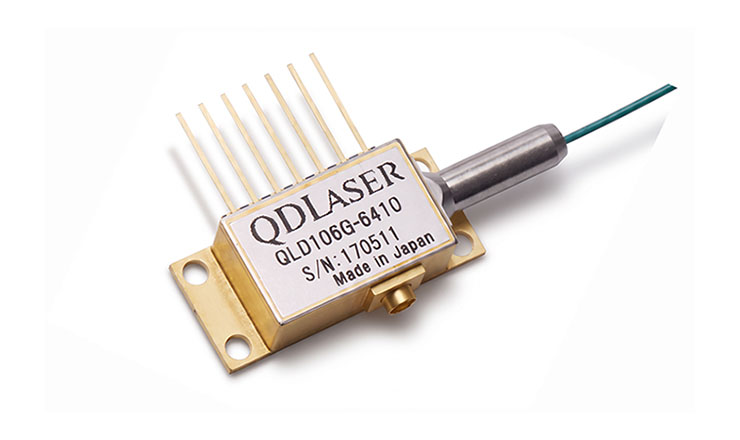
Nanosecond and Picosecond Laser
Short pulses, stable wavelengths, and a compact form factor: QD Laser DFB lasers enable pulse widths ranging from the picosecond to the nanosecond domain. They are ideally suited as precise seed lasers for fiber lasers, time-resolved measurements, LiDAR, sensing applications, and industrial micromachining. IMM Photonics supports you in product selection, driver electronics, and system integration, from the laser diode itself to a fully customized assembly.
Compact pulsed DFB Lasers for demanding systems
In a Distributed Feedback (DFB) laser, an integrated grating selects a preferred longitudinal mode. This supports stable single-longitudinal-mode operation and a well-defined center wavelength. The short optical pulses are generated through direct electrical modulation: in nanosecond operation, the optical emission follows the driving current pulse, while in picosecond operation, gain switching generates a short optical pulse immediately after the laser threshold is exceeded.
Typical applications
Nano- and picosecond lasers are widely used as precise seed lasers for fiber laser systems, where the DFB laser defines the wavelength, pulse duration, repetition rate, polarization, and spectral characteristics, while subsequent fiber amplifiers increase the optical output power. In micromachining and semiconductor inspection, short pulses support highly precise processes with reduced thermal impact, depending on the material, pulse energy, and process parameters. Furthermore, picosecond pulses serve as short optical excitation sources or timing references in time-resolved measurement systems. For LiDAR and time-of-flight (ToF) ranging applications, picosecond pulses improve the fundamental timing resolution. The achievable system accuracy, however, also depends on factors such as detector bandwidth, timing jitter, signal-to-noise ratio, optical design, and signal processing. In addition, well-defined wavelengths and pulsed operation open up a wide range of applications in spectroscopy, sensing, and nonlinear optics.
From Laser Diode to production-ready solution
IMM Photonics supports customers throughout both technical product selection and system integration. Depending on the project requirements, we can assist with the optimization of the laser diode, driver electronics, temperature control, optics, mechanical design, and fiber interface. This approach enables the transformation of a suitable DFB laser source into a ready-to-integrate solution, from feasibility studies and prototypes through to volume production. Do you require short, spectrally defined optical pulses for your application? Send us your technical requirements. We will evaluate the most suitable laser diode, a matched driver system, or a customized integration solution for your project.
Find the Right Nanosecond and Picosecond Lasers
| Designation | Wavelength | Optical Power | Housing | Pulse Duration |
|---|---|---|---|---|
1018 - 1122 nm | 100 mW | 14-pin Butterfly | ns | |
1018 - 1122 nm | 100 mW | 14-pin Butterfly | ps | |
1018 - 1122 nm | 130 mW | 14-pin Butterfly | ps | |
1018 - 1122 nm | 300 mW | 14-pin Butterfly | ns | |
1018 - 1188 nm | 50 mW | Driver board | ns | |
| 1030 nm | 50 mW | 7-pin Butterfly | ps | |
1030 nm | 50 mW | 7-pin Butterfly | ns | |
1030 nm | 50 mW | Driver board | ps | |
| 1064 nm | 130 mW | 14-pin Butterfly | ps | |
| 1064 nm | 130 mW | 14-pin Butterfly | ps | |
| 1064 nm | 400 mW | 14-pin Butterfly | ns |
Frequently Asked Questions (FAQs) About Nanosecond and Picosecond Laser
The designation refers to the duration of the optical pulses. A nanosecond corresponds to 10⁻⁹ seconds, while a picosecond corresponds to 10⁻¹² seconds. In the semiconductor lasers described here, short pulses are generated through direct electrical modulation or gain switching.
In nanosecond operation, the optical output power follows the applied current pulse relatively directly. In gain-switching operation, the laser diode is driven dynamically above the lasing threshold, allowing a significantly shorter picosecond optical pulse to be generated from a much longer electrical pulse.
The integrated grating of a DFB laser supports the selection of a preferred longitudinal mode. This enables stable single-mode operation and a well-defined center wavelength, which are important characteristics for seed lasers, measurement systems, and optical amplifier architectures.
Depending on the product family, pulse widths of approximately 15 ps, 50 ps, and nanoseconds are available. The portfolio covers numerous wavelengths in the 1 µm range, with particularly relevant variants at 1030 nm and 1064 nm. Availability should always be verified against the current part number.
Selected picosecond laser variants achieve peak powers of approximately 50 mW. Depending on the specific model, nanosecond laser variants are available with peak powers of approximately 100 mW to 400 mW. The permissible output power depends on pulse width, repetition rate, duty cycle, temperature, and driving conditions.
Yes. Several product families have been specifically designed for this purpose. The DFB laser serves as the master oscillator, defining key optical and temporal characteristics, while a downstream fiber amplifier increases the output power.
Yes. Reproducible gain-switching operation requires fast electrical pulses, controlled impedance matching, and a properly designed RF signal chain. The QCED106G series offers a compact solution including a driver board and software-assisted parameter configuration.
For rectangular pulses, the simplified relationship is: Average Power = Peak Power × Pulse Width × Repetition Rate
With very low duty cycles, peak power can be high while average power remains comparatively low.
For rectangular pulses, the simplified relationship is: Average Power = Peak Power × Pulse Width × Repetition Rate
With very low duty cycles, peak power can be high while average power remains comparatively low.For an ideal time-of-flight (ToF) system, the theoretical range resolution can be approximated by: ΔR = c × τ / 2
where: ΔR = range resolution, c = speed of light, τ = pulse width
A 15 ps pulse corresponds to a theoretical range resolution of approximately 2.25 mm. In practice, real-world systems do not automatically achieve this value, as detector bandwidth, timing jitter, signal-to-noise ratio, optical design, and signal processing all impose additional limitations.
A PERSONAL CONVERSATION Feel free to call us or send us an email via the following link Kontakt