Laser diodes 532, 561 and 594 nm
Laser Diodes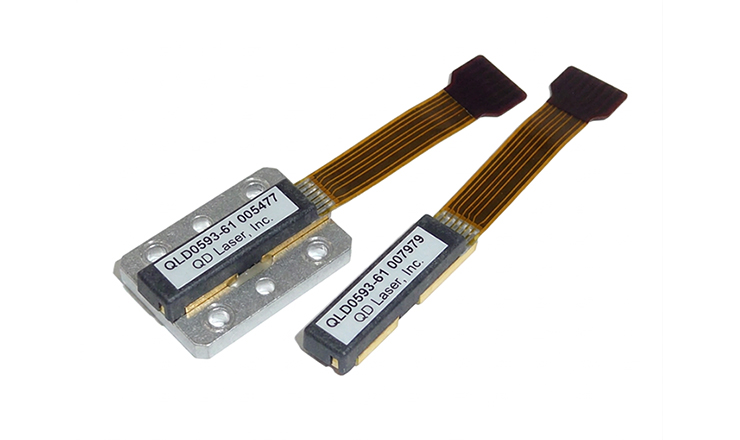
Laser diodes and laser modules at 532 nm, 561 nm and 594 nm
Compact visible laser sources for demanding OEM systems: The QLD0593 series from QD Laser generates narrow-linewidth single-frequency laser light at 532 nm, 561 nm, or 594 nm. Depending on the variant, the modules provide up to 50 mW optical output power, direct modulation from DC to 100 MHz, and support both CW and pulsed operation. These frequency-doubled laser modules are particularly well suited for flow cytometry, fluorescence and STED microscopy, Raman spectroscopy, interferometry, and time-resolved measurement applications.
How do QLD0593 laser modules generate visible laser light?
QLD0593 laser modules combine an NIR DFB semiconductor laser, an integrated Semiconductor Optical Amplifier (SOA), and a nonlinear crystal for frequency doubling. The infrared fundamental wavelength is converted into visible wavelengths of 532 nm, 561 nm, and 594 nm. The result is an electrically controllable, narrow-linewidth single-frequency laser source offering high stability and excellent beam quality.
Advantages of 532 nm to 594 nm laser diodes and laser modules
The QLD0593 series provides visible laser sources at 532 nm, 561 nm, and 594 nm with high spectral purity, excellent beam quality, and a particularly compact design. Single-frequency operation, direct modulation up to 100 MHz, and CW as well as variant-dependent pulsed operation support precise and dynamic measurement processes. With dimensions of only 22 × 5.6 × 3.8 mm and a typical power consumption of 0.8 W, these modules can be integrated efficiently into medical, scientific, and industrial OEM systems where space and power consumption are critical.
Typical applications for 532 nm, 561 nm and 594 nm lasers
Laser modules at 532 nm, 561 nm, and 594 nm are widely used in flow cytometry and cell sorting, fluorescence microscopy, laser microscopy and STED microscopy, Raman spectroscopy, interferometry, and time-resolved measurement techniques. For STED microscopy, not only the wavelength but also the availability of short pulses in the picosecond range is important to support precise synchronization between excitation and emission light.
The narrow-linewidth single-frequency emission enables precise excitation and reliable spectral separation. Excellent beam quality, compact dimensions, and direct modulation up to 100 MHz facilitate integration into analytical instruments, measurement systems, and custom OEM laser solutions.
From a 532 nm, 561 nm or 594 nm laser source to a production-ready OEM solution
IMM Photonics supports you throughout the selection and integration of the optimal laser source for your application. We tailor the laser module, driver electronics, temperature control, collimation, beam shaping, and fiber interface to your application requirements and available installation space. This transforms a QD Laser module into a fully integrated, ready-to-install OEM solution, from feasibility studies and prototype development through to volume production. Request the right laser source for your application
Find the right Laser Diode for your application:
| Designation | Wavelength | Optical Power | Mounting Plate | Gain-Switching Operation |
|---|---|---|---|---|
| 532 nm | 15 mW | Yes | No | |
| 532 nm | 20 mW | No | No | |
| 532 nm | 20 mW | Yes | No | |
| 532 nm | 20 mW | Yes | No | |
| 532 nm | 20 mW | Yes | Yes | |
| 532 nm | 25 mW | Yes | No | |
| 532 nm | 25 mW | Yes | Yes | |
| 532 nm | 30 mW | No | No | |
| 532 nm | 30 mW | No | No | |
| 532 nm | 30 mW | Yes | No | |
| 532 nm | 30 mW | Yes | Yes | |
| 532 nm | 50 mW | No | No | |
| 532 nm | 50 mW | No | Yes | |
| 532 nm | 50 mW | Yes | No | |
| 532 nm | 50 mW | Yes | Yes | |
| 561 nm | 2 mW | Yes | No | |
| 561 nm | 15 mW | Yes | No | |
| 561 nm | 20 mW | No | No | |
| 561 nm | 20 mW | Yes | No | |
| 561 nm | 20 mW | Yes | No | |
| 561 nm | 20 mW | Yes | Yes | |
| 561 nm | 25 mW | Yes | No | |
| 561 nm | 25 mW | Yes | Yes | |
| 561 nm | 30 mW | No | No | |
| 561 nm | 30 mW | No | Yes | |
| 561 nm | 30 mW | Yes | No | |
| 561 nm | 30 mW | Yes | Yes | |
| 561 nm | 50 mW | No | No | |
| 561 nm | 50 mW | No | Yes | |
| 561 nm | 50 mW | Yes | No | |
| 561 nm | 50 mW | Yes | Yes | |
| 594 nm | 2 mW | Yes | Yes | |
| 594 nm | 5 mW | No | No | |
| 594 nm | 5 mW | No | Yes | |
| 594 nm | 5 mW | Yes | No | |
| 594 nm | 5 mW | Yes | Yes |
Frequently Asked Questions about 532 nm to 594 nm laser diodes
No. They are compact hybrid laser modules. An NIR DFB semiconductor laser generates the fundamental wavelength, an SOA amplifies it, and a nonlinear crystal doubles the frequency. This process generates visible laser light at 532 nm, 561 nm, or 594 nm. While the term “laser diode” is helpful for category searches, the technically accurate description is “frequency-doubled visible laser module.”
The QLD0593 series generally includes versions with 5 mW, 20 mW, 30 mW, and 50 mW output power. The actual power available depends on wavelength, package type, and specific part number.
Single frequency refers to operation on a single dominant longitudinal mode. The integrated DFB grating selects the NIR fundamental wavelength, and the frequency-doubling process preserves a narrow-linewidth visible output. This makes the modules particularly suitable for precision spectroscopy, interferometry, and fluorescence excitation.
Yes. The integrated SOA can be driven electrically. QD Laser specifies direct modulation from DC to 100 MHz, allowing some systems to eliminate the need for an external optical modulator.
Yes, for suitable variants and with appropriately matched driver electronics. QD Laser specifies the generation of pulses with durations as short as 50 ps. Pulse width, repetition rate, peak power, and duty cycle should be verified for the specific laser and driver combination used.
The choice depends on factors such as sample absorption characteristics or fluorescence excitation requirements, detector spectral sensitivity, filter availability, background signal levels, and the intended measurement technique. For flow cytometry, 561 nm is often particularly important. For Raman spectroscopy, microscopy, and interferometry, the suitability of 532 nm, 561 nm, or 594 nm should be evaluated based on the specific application.
Yes. Fiber-coupled versions at 532 nm and 561 nm are available with MMF, SMF, or PMF fiber options. In addition, QD Laser offers the Lantana series, a driver-integrated plug-and-play module available at 532 nm, 561 nm, and 594 nm. Output power, dimensions, and interfaces differ from those of the compact QLD0593 modules.
A PERSONAL CONVERSATION Feel free to call us or send us an email via the following link Kontakt

You need to load content from reCAPTCHA to submit the form. Please note that doing so will share data with third-party providers.
More InformationYou are currently viewing a placeholder content from Turnstile. To access the actual content, click the button below. Please note that doing so will share data with third-party providers.
More InformationYou need to load content from hCaptcha to submit the form. Please note that doing so will share data with third-party providers.
More InformationYou need to load content from reCAPTCHA to submit the form. Please note that doing so will share data with third-party providers.
More InformationYou need to load content from reCAPTCHA to submit the form. Please note that doing so will share data with third-party providers.
More InformationYou need to load content from reCAPTCHA to submit the form. Please note that doing so will share data with third-party providers.
More InformationYou need to load content from Turnstile to submit the form. Please note that doing so will share data with third-party providers.
More Information