DFB laser diodes & DM laser diodes
Laser Diodes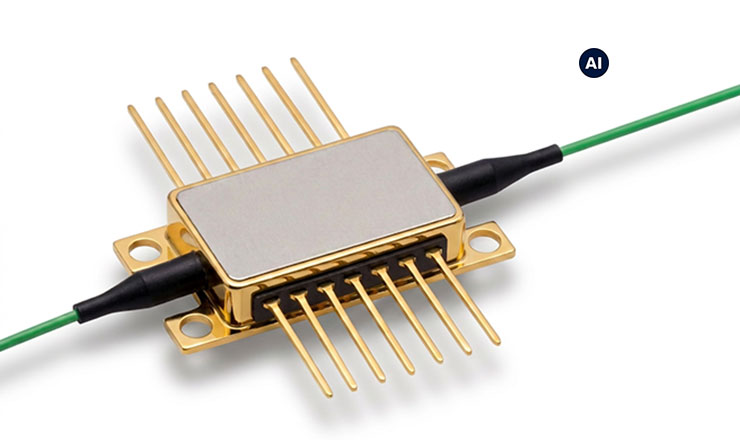
Narrow-band DFB laser diodes and DM laser diodes for sensor technology, spectroscopy, LiDAR, optical communications, and industrial OEM systems
DFB laser diodes and DM (Discrete Mode) laser diodes primarily generate longitudinal single-mode laser light. High side-mode suppression ratio (SMSR), narrow linewidth, and defined tuning characteristics support reliable measurements, stable data transmission, and phase- and frequency-based methods such as interferometry or FMCW LiDAR. IMM Photonics supports you in technical selection and integration—from the laser diode through drivers, temperature control, and optics to custom laser systems.
DFB and DM Technology: Precise Mode Selection
In a DFB laser, a periodic grating is integrated into or near the active waveguide. Interference from the Bragg grating results in wavelength-selective reflection and enables stable single-frequency operation. The Bragg wavelength is approximately determined by λB ≈ 2 · neff · Λ. DM lasers from Eblana Photonics, on the other hand, are based on a Fabry–Pérot cavity with a few strategically positioned, near-surface etched refractive index perturbations. These shape the wavelength-dependent loss spectrum so that a selected mode is preferentially excited. The regrowth-free DM platform combines precise wavelength selection with a scalable manufacturing approach.
Product Platforms for Different Requirements
High-Power DFB Laser Diodes from Seminex
SemiNex offers DFB laser diodes in the O-band and C-band, particularly at 1310 nm and 1550 nm. High optical power, narrow linewidth, high SMSR, and low relative intensity noise (RIN) support optical networks, silicon photonics, co-packaged optics, ELSFP architectures, and coherent LiDAR systems. Multi-channel and multi-wavelength arrays can be customized for specific projects.
Discrete-Mode Laser Diodes from Eblana Photonics
Eblana Photonics’ patented discrete-mode technology enables narrow-band laser sources with freely selectable target wavelengths in the near-infrared range; the overall portfolio, including other technologies, ranges from 689 nm to 2327 nm. DM lasers are specifically designed for gas detection, TDLAS, spectroscopy, LiDAR, fiber optics, and measurement technology. Available package options include TO-39, TO-56, 7-pin, and 14-pin butterfly packages, as well as custom designs.
DFB Seed Lasers from QD Laser
QD Laser offers DFB seed lasers ranging from 1018 to 1122 nm and from 1140 to 1188 nm, selectable in 1-nm increments. Depending on the series, CW, nanosecond, and picosecond operation, as well as compatible drivers, are available. Typical fields of application include fiber lasers, microprocessing, semiconductor inspection, LiDAR, and nonlinear frequency conversion.
Typical Applications
Gas detection, TDLAS, optical communications, data centers, LiDAR, and fiber lasers are just a few of the typical applications, followed by micro-machining, fiber optics, interferometry, and metrology. Depending on the application, the focus is on precise tuning to absorption lines, defined wavelengths for optical data transmission at 1310 nm or 1550 nm, narrow linewidth and high frequency stability, short pulses, or coherent seed signals. The appropriate DFB or DM laser diode is therefore selected based on wavelength, operating mode, power, tuning characteristics, and system architecture.
Selecting the Right Laser Diode for Your Application
More than just wavelength and output power are required for a reliable preliminary selection. Key factors include linewidth, SMSR, RIN, wavelength tolerance, temperature and current tuning, modulation bandwidth, operating mode, fiber or free-space interface, polarization, back reflections, housing, operating temperature, and quantity. Data sheet values always apply to defined operating conditions and cannot be applied to other variants without verification.
Request a DFB or DM laser diode
Discuss your requirements with our laser experts. We will evaluate suitable standard products and custom integration options.
Find the right DFB and DM Laser Diode for your application:
| Designation | Wavelength | Optical Power | Housing | Linewidth |
|---|---|---|---|---|
| 689 nm | 2 mW | 14 Pin Butterfly | 3 MHz | |
| 689 nm | 2.5 mW | TO 39 | 4 MHz | |
| 760-761 nm | 15 mW | TO39 | 5 MHz | |
| 763 nm | 5 mW | 14 Pin Butterfly | 5 MHz | |
| 780 nm | 6 mW | 14 Pin Butterfly | 3 MHz | |
| 1032 nm | 30 mW | 14 Pin Butterfly | 2 MHz | |
| 1032 nm | 50 mW | 14 Pin Butterfly | 2 MHz | |
| 1060 nm | 10 mW | 14 Pin Butterfly | 2 MHz | |
| 1060 nm | 50 mW | 14 Pin Butterfly | 2 MHz | |
| 1064 nm | 50 mW | 14 Pin Butterfly | 2 MHz (approx.) | |
| 1064 nm | 50 mW | 14 Pin Butterfly | 2 MHz (approx.) | |
| 1064 nm | 50 mW | 14 Pin Butterfly | 2 MHz (approx.) | |
| 1064 nm | 50 mW | 14 Pin Butterfly | 2 MHz (approx.) | |
| 1083 nm | 30 mW | 14 Pin Butterfly | 2 MHz | |
| 1083 nm | 50 mW | 14 Pin Butterfly | 2 MHz | |
| 1122 nm | 30 mW | 14 Pin Butterfly | 2 MHz | |
| 1122 nm | 50 mW | 14 Pin Butterfly | 2 MHz | |
| 1278 nm | 15 mW | TO 39 | 2 MHz | |
| 1278 nm | 8 mW | 14 Pin Butterfly | 2 MHz | |
| 1305 nm | 14 mW | 14 Pin Butterfly | 2 MHz | |
| 1310 nm | 20 mW | 14 Pin Butterfly | 2 MHz | |
| 1310 nm | 60 mW | 14 Pin Butterfly | 150 kHz | |
| 1310 nm | 90 mW | 14 Pin Butterfly | 300 kHz | |
| 1311 nm | 190 mW | 14 Pin Butterfly | 200 kHz | |
| 1342 nm | 12 mW | 14 Pin Butterfly | 2 MHz | |
| 1392 nm | 19 mW | TO 39 | 2 MHz | |
| 1392 nm | 8 mW | 14 Pin Butterfly | 2 MHz | |
| 1512 nm | 10 mW | 14 Pin Butterfly | 2 MHz | |
| 1512 nm | 15 mW | TO 39 | 2 MHz | |
| 1530 nm | 70 mW | 14 Pin Butterfly | 50 MHz | |
| 1550 nm | 10 mW | 14 Pin Butterfly | 800 MHz | |
| 1550 nm | 10 mW | TO 39 | 800 MHz | |
| 1550 nm | 100 mW | 14 Pin Butterfly | 300 kHz | |
| 1550 nm | 40 mW | 14 Pin Butterfly | 140 kHz | |
| 1550 nm | 5 mW | 14 Pin Butterfly | 100 MHz | |
| 1550 nm | 50 mW | 14 Pin Butterfly | 1 MHz | |
| 1550 nm | 6 mW | 14 Pin Butterfly | 200 MHz | |
| 1550 nm | 70 mW | 14 Pin Butterfly | 100 MHz | |
| 1565 nm | 8 mW | 7 Pin Butterfly | not specified | |
| 1580 nm | 6 mW | 14 Pin Butterfly | 2 MHz | |
| 1625 nm | 12.5 mW | TO39 | 2 MHz | |
| 1625 nm | 12.5 mW | TO39 | 2 MHz | |
| 1625 nm | 7.5 mW | 14 Pin Butterfly | 2 MHz | |
| 1653 nm | 6 mW | 14 Pin Butterfly | 2 MHz | |
| 1653 nm | 8 mW | TO39 | 2 MHz | |
| 1692 nm | 5 mW | 14 Pin Butterfly | 2 MHz | |
| 1742 nm | 5 nm | 14 Pin Butterfly | 2 MHz | |
| 1742 nm | 6 mW | TO39 | 2 MHz | |
| 1854 nm | 3 mW | 14 Pin Butterfly | 2 MHz | |
| 1854 nm | 5 mW | TO39 | 2 MHz | |
| 1877 nm | 3 mW | 14 Pin Butterfly | 2 MHz | |
| 1877 nm | 5 mW | TO39 | 2 MHz | |
| 1950 nm | 2 mW | 14 Pin Butterfly | 2 MHz | |
| 1952 nm | 12 mW | 14 Pin Butterfly | 5 MHz | |
| 2000 nm | 1.75 mW | 7 Pin Butterfly | not specified | |
| 2004 nm | 2 mW | 14 Pin Butterfly | 2 MHz | |
| 2004 nm | 5 mW | TO39 | 2 MHz | |
| 2051 nm | 1.5 mW | 14 Pin Butterfly | 2 MHz | |
| 2051 nm | 10 mW | 14 Pin Butterfly | 5 MHz | |
| 2121 nm | 4 mW | TO39 | 2 MHz | |
| 2200 nm | 0.8 mW | 14 Pin Butterfly | 2 MHz | |
| 2327 nm | 2 mW | TO39 | 2 MHz |
Frequently Asked Questions (FAQs) About DFB Laser Diodes and DM Laser Diodes
DFB and DM laser diodes enable precise wavelength selection for absorption lines, telecommunications bands (O- and C-bands), and seed applications. Their stable single-mode or single-frequency operation, high SMSR, and narrow linewidth support spectroscopy, interferometry, coherent measurement techniques, and reliable data transmission. Depending on the product, direct modulation as well as CW, nano-, or picosecond operation are possible. Various TO packages and fiber-coupled butterfly modules facilitate integration; IMM Photonics also provides support for optics, electronics, thermal management, and series integration.
A DFB laser diode is a semiconductor laser with distributed optical feedback. An integrated grating selects a narrow spectral range and typically enables a dominant longitudinal mode, high SMSR, and a narrow linewidth.
In a DFB laser, a Bragg grating distributed across the cavity performs mode selection. In a DM laser, a few discrete index perturbations shape the loss spectrum of a Fabry-Pérot resonator. Both designs can provide narrowband single-mode operation; their specific suitability depends on wavelength, power, tuning, package, and application.
Key factors include central wavelength and tolerance, optical power, linewidth, SMSR, RIN, threshold and operating current, tuning coefficients, modulation characteristics, polarization, temperature range, back reflection tolerance, and housing. The priority of these factors depends on the specific measurement or transmission application.
A laser diode whose tunable range reliably covers the selected absorption line is suitable. Additionally, a narrow linewidth, high SMSR, reproducible current- and temperature-based tuning, and a mode-hopping-free tuning range are important. The target wavelength must be determined based on the gas, pressure, temperature, and possible interfering factors.
For FMCW LiDAR, linewidth, frequency stability, tuning linearity, and low noise are the key considerations. For pulsed ToF systems, pulse width, peak power, repetition rate, and suitability as a seed for an optical amplifier are critical. The selection must therefore be based on the system architecture.
Yes. IMM Photonics can evaluate suitable laser diodes and integrate them with a driver, temperature control, optics, mechanics, and a fiber interface to create an application-specific assembly or a production-ready laser module.
A PERSONAL CONVERSATION Feel free to call us or send us an email via the following link Kontakt