Laser Diode Chips
Laserdioden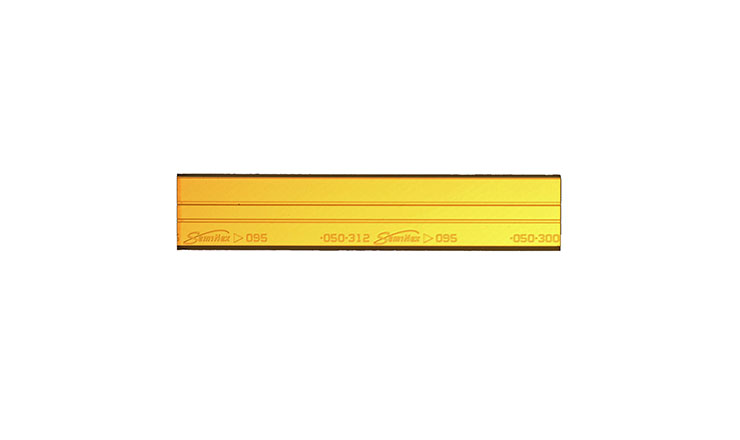
High Power Laser Dioden Chips for custom OEM laser solutions
Infrared Laser Diode Chips – Select with Precision, Integrate with Flexibility
Laser diode chips are bare-die semiconductor lasers designed for direct integration into optoelectronic assemblies. They generate laser light through electrical excitation and serve as the active light source in a custom laser system. Mounting, heat dissipation, drive circuitry, and optical coupling are tailored to the specific application.
IMM Photonics supports you in selecting and integrating suitable laser diodes. For infrared OEM laser sources, laser chips from SemiNex, among others, are suitable options. Laser diode chips are available in both single-mode and multimode versions.
Direct Integration Instead of a Predefined Housing Design
A laser chip offers flexibility for custom thermal, electrical, and optical interfaces. This is particularly advantageous when installation space, beam guidance, or integration into an existing assembly requires a customized solution. To achieve this, chip mounting, bonding, protection against electrostatic discharge (ESD), and protection of the exposed facets must be taken into account during the design phase.
If a pre-structured assembly is more suitable, a chip-on-submount or chip-on-carrier design may be an alternative. However, a carrier does not replace either complete system cooling or the protection provided by a sealed housing. Fiber-coupled and housed laser diodes may also be appropriate, depending on the integration goal.
Wavelength, Power, and Beam Quality Suited to the Application
The appropriate wavelength of a laser diode chip depends on your application. In addition to the wavelength and its tolerance, the optical power, operating current, and temperature conditions are also critical factors in the selection process.
Multimode or broad-area chips are often suitable for high optical power applications. If focusability or coupling into a single-mode fiber is critical, you will need a single-mode laser. Single-mode operation does not automatically imply narrow-band, single-frequency emission: For coherent measurement methods, linewidth and frequency stability must also be specified.
Optimized for Your OEM Application
Infrared laser chips enable custom light sources for medical and dermatological laser systems, LiDAR and distance measurement, as well as measurement, testing, and research applications. The selection depends on wavelength, power, operating mode, and system design. For ToF systems, pulse parameters and detector design are particularly relevant; FMCW LiDAR as well as spectroscopic and interferometric applications place additional demands on the spectral characteristics and, where applicable, the coherence of the source.
From technical component selection to custom assemblies
IMM Photonics combines consulting with expertise in optics, electronics, mechanics, and thermal management. We support you in the technical preselection process and evaluate the appropriate integration approach—from individual components through optical coupling to custom optoelectronic assemblies. We coordinate the scope of development, feasibility, and mass-production requirements with you.
Find the right laser diode chip for your application:
| Designation | Wavelength | Optical Power | Operating Mode | Type |
|---|---|---|---|---|
| 1310 nm | 0.35 Watt | CW | Bar | |
| 1310 nm | 0.45 Watt | CW | Chip | |
| 1310 nm | 5.7 Watt | CW | Chip | |
| 1310 nm | 30 Watt | CW | Bar | |
| 1350 nm | 5.6 Watt | CW | Chip | |
| 1350 nm | 28 Watt | CW | Bar | |
| 1450 nm | 5 Watt | CW | Chip | |
| 1470 nm | 5 Watt | CW | Chip | |
| 1470 nm | 7 Watt | CW | Chip | |
| 1470 nm | 7 Watt | CW | Chip | |
| 1470 nm | 20 Watt | CW | Bar | |
| 1470 nm | 28 Watt | CW | Bar | |
| 1550 nm | 0.35 Watt | CW | Bar | |
| 1550 nm | 0.6 Watt | CW | Chip | |
| 1550 nm | 4.2 Watt | CW | Chip | |
| 1550 nm | 14 Watt | PW | Chip | |
| 1550 nm | 14 Watt | PW | Chip on Carrier | |
| 1550 nm | 25 Watt | PW | Chip | |
| 1550 nm | 30 Watt | PW | Chip on Carrier | |
| 1550 nm | 35 Watt | PW | Chip | |
| 1550 nm | 35 Watt | PW | Chip on Carrier | |
| 1550 nm | 40 Watt | PW | Chip | |
| 1550 nm | 40 Watt | PW | Chip on Carrier | |
| 1550 nm | 50 Watt | PW | Chip | |
| 1550 nm | 50 Watt | PW | Chip on Carrier | |
| 1550 nm | 60 Watt | PW | Chip | |
| 1550 nm | 80 Watt | PW | Chip | |
| 1550 nm | 80 Watt | PW | Chip on Carrier | |
| 1550 nm | 100 Watt | PW | Chip | |
| 1550 nm | 100 Watt | PW | Chip on Carrier | |
| 1560 nm | 27.5 Watt | CW | Bar | |
| 1560 nm | 30 Watt | PW | Chip on Carrier | |
| 1620 nm | 0.45 Watt | CW | Chip | |
| 1726 nm | 2.7 Watt | PW | Chip | |
| 1726 nm | 2.7 Watt | CW | Chip on Carrier | |
| 1940 nm | 1.1 Watt | CW | Chip |
Frequently Asked Questions About Laser Diode Chips
A laser diode chip is the active semiconductor component of a laser diode without a housing (bare die). Within the appropriate operating range, it generates laser light through electrical excitation. Only after integration—including assembly, bonding, heat dissipation, and, if necessary, optics or a housing—does it become a laser source suitable for specific applications.
The laser chip is the bare component. In chip-on-carrier or chip-on-submount configurations, it is already mounted on a carrier. A laser module integrates additional functions, such as beam shaping, fiber coupling, temperature control, or drive circuitry. The specific functions included depend on the particular product.
The available wavelength depends on the specific chip variant. Please let us know your desired wavelength and the acceptable tolerance. We will review suitable laser diode chips as well as options for custom variants. We will determine the specific specifications and availability on a project-by-project basis.
Power output depends on the part number, operating mode, operating current, and thermal conditions. The value listed in the data sheet under the specified test conditions is decisive. Continuous-wave (CW) power and pulse peak power are not interchangeable; chip output power and usable power after optical or fiber coupling may also differ from one another.
Single-mode operation refers to a single transverse mode and is important for good focusability. Multimode chips can enable higher power, but require appropriate beam shaping and coupling. Single-mode does not mean single-frequency: For a narrowband source, the longitudinal modes and linewidth must also be taken into account.
Only within the conditions approved for the specific chip. A CW specification does not allow for an arbitrary increase in pulse current. Pulse duration, peak current, duty cycle, and thermal load must be aligned with the manufacturer’s specifications.
The assembly must make reliable contact with the chip and dissipate the heat generated. The heat sink temperature and the active chip temperature are not the same. The permissible temperatures, the thermal path, ESD protection, and the handling of exposed facets are therefore part of the integration planning. The manufacturer’s assembly and operating instructions are authoritative.
No. Wavelength alone does not guarantee eye safety. The accessible radiation, power, pulse parameters, beam geometry, and exposure conditions of the entire system must be evaluated. Laser safety and classification must be assessed in accordance with the applicable regulations and standards, in particular IEC or EN 60825-1.
No. FMCW LiDAR requires a suitable coherent source. A suitable linewidth and a precisely tunable optical frequency are crucial. For silicon photonics, the mode field, coupling, back reflections, assembly, and thermal interfaces are also important. Laser chips, gain chips, and semiconductor amplifiers (SOA/RSOA) perform different functions and are not universally interchangeable.
Please specify the application, wavelength, and tolerance; optical power; operating mode; temperature range; desired integration; and quantity. For pulsed lasers, pulse duration, repetition rate, and duty cycle are important. For procurement, the project schedule, annual demand, and requirements regarding test reports, traceability, and change management are also helpful.
A PERSONAL CONVERSATION Feel free to call us or send us an email via the following link Kontakt